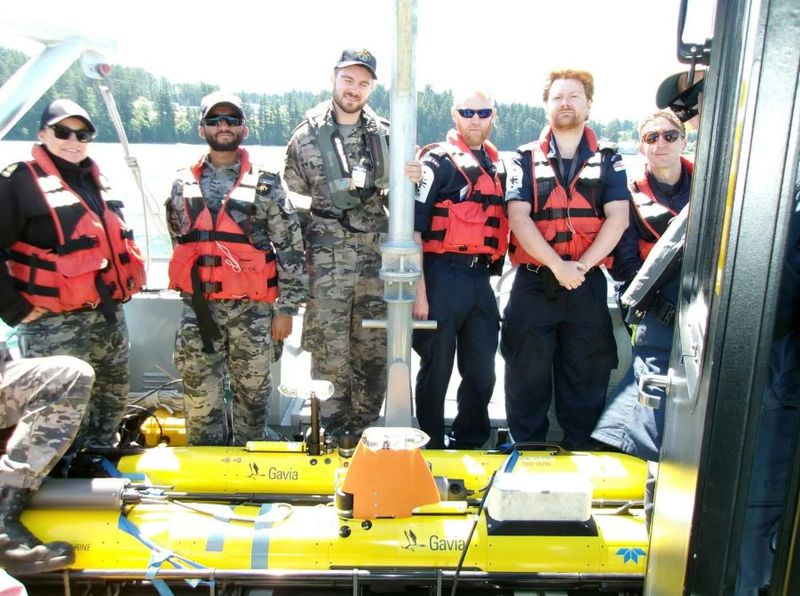
The navies of the UK, Australia and the US have tested personnel and advanced underwater technologies during Exercise Lanternfish, demonstrating how the three AUKUS partners could work together to protect critical undersea infrastructure.
Royal Navy divers and hydrographic specialists joined U.S. and Australian personnel during the six-week Exercise Lanternfish, which took place in Virginia, Washington and waters off southwestern Australia, to operate and evaluate remotely operated and autonomous underwater systems.
During the exercise, the Royal Navy's Diving and Threat Exploitation Group deployed the VideoRay Defender, a remotely operated vehicle designed to detect mines and other underwater explosive devices. Meanwhile, the Hydrographic eXploitation Group (HXG) used the Teledyne Gavia autonomous underwater vehicle, a modular platform that can be configured with different sensor payloads for a range of missions.
The systems were employed to conduct surveillance of critical undersea infrastructure and support training scenarios involving potential subsea threats. They operated alongside other sensors and underwater vehicles to improve situational awareness and underwater domain monitoring.
The goal was to improve how nations detect, monitor and respond to potential threats below the surface, allowing participants to share expertise, collaborate and develop common operating procedures.
The exercise was conducted under the AUKUS Pillar 2 trilateral defence agreement, which concentrates on collaborative, accelerated deployment of advanced military capabilities by the three partner nations.
The exercise Lanternfish also reflected the Royal Navy’s transition towards a Hybrid Navy, where crewed and uncrewed capabilities work alongside each other to enhance operational effectiveness.
“These events provide a fantastic opportunity to test our interoperability in a real world setting and allow us to iterate our capabilities at pace,” said Commodore Marcus Rose, Deputy Director Defence Underwater.
Planning for the next AUKUS Pillar 2 operational exercise, to demonstrate allied and partner integration across maritime, air, cyber and space domains, is already underway.