

Decommissioning delays for US Navy attack submarines could cost more than $3.1 billion over the next five years as shipyards struggle to keep pace with the number of vessels awaiting retirement, according to a new report published by the US Government Accountability Office (GAO).
The growing backlog adds to existing maintenance challenges that have already cost the US Navy more than 15,000 operational days over the past decade and an estimated $3.4 billion. Limited shipyard capacity is now affecting submarines at the end of their service lives, preventing the navy from starting the decommissioning process on schedule.
Attack submarines provide the US Navy with intelligence, surveillance and reconnaissance capabilities and the ability to conduct strikes against enemy targets while operating covertly. As more submarines reach the end of their service lives, delays in decommissioning could further constrain shipyard capacity and increase costs.
Lost operational days include delays completing depot maintenance and active idle time. Active idle time describes a period when an attack submarine and its crew must remain pier-side because they are no longer certified to conduct normal operations and cannot be inducted into a maintenance period.
In addition to lost operational days, the Navy faces significant challenges with managing inactive idle time for attack submarines, as reported by the GAO. Inactive idle time describes when an attack submarine designated for decommissioning cannot be inducted into a dry dock in a shipyard. As a result, the submarine and its crew must remain pier-side until a shipyard has the capacity in a dry dock to defuel its nuclear reactor.
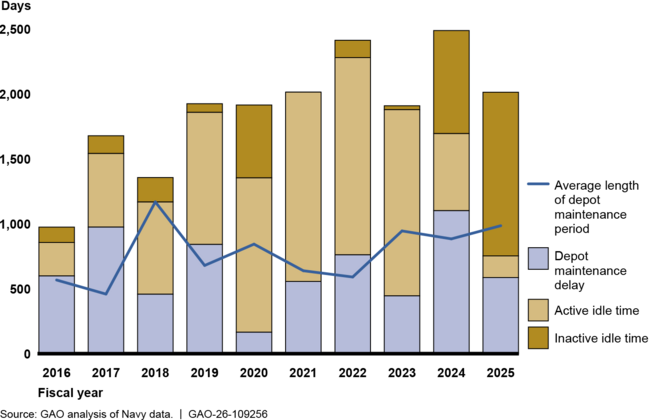
The US Navy has made progress in reducing active idle time, but inactive idle time for submarines has continued to grow and is expected to worsen. The GAO estimates that 15 attack submarines could enter inactive idle time between fiscal years 2026 and 2030, resulting in more than 14,000 idle days and $3.1 billion in operating and support costs.
The GAO also found that the US Navy has not fully evaluated alternative options to more efficiently decommission attack submarines and develop and implement an inactivation plan that could allow it to reduce inactive idle time for crews and save billions.
The office analyzed US Navy attack submarine maintenance data from fiscal years 2016 through 2025. According to the US Navy, its 44 attack submarines, as of fiscal year 2025, provide the United States an asymmetric advantage to gather intelligence undetected and attack enemy targets, among other missions. These capabilities make attack submarines some of the most requested assets by the global combatant commanders.
The GAO issued two recommendations to the Department of the Navy aimed at reducing delays in the decommissioning of attack submarines.
The first calls on the navy to evaluate alternative methods for decommissioning submarines more efficiently and improving shipyard capacity for the operational fleet. Potential measures include defueling submarines outside dry docks and reducing crew levels for vessels awaiting decommissioning.
The second recommendation calls for the navy to use that evaluation to develop and implement an inactivation plan aimed at reducing inactive idle time for both crews and submarines. The plan should establish specific steps and timelines for monitoring progress and mitigating risks.