

The Royal Navy’s first-ever autonomous squadron, which will operate uncrewed boats in front-line operations, has been launched.
The Royal Navy formally commissioned the 1st Autonomous Squadron in a ceremony on November 5 at HMS Naval Base Portsmouth. The milestone moment shows the Royal Navy’s commitment to continuing to move towards a hybrid navy where traditional warships and units will integrate with uncrewed and autonomous technology. The hybrid navy is backed by a £1.5 billion investment over four years.
The squadron comprises around 180 personnel, the same as a Type 23 frigate, split into two watches to sustain operations around the clock. It will replace Project Beehive, the navy’s initial program to procure a fleet of autonomous and crewless boats as a proving ground for its hybrid navy technologies.
The squadron will conduct a range of operations alongside other organizations and international partners, operating both independently and as part of a task group. It will also focus on expanding the Royal Navy’s uncrewed surface vessel (USV) fleet, bringing new platforms into service and developing the squadron’s capabilities.
The expansion will be carried out in close cooperation with Navy Develop, the Navy’s Disruptive Capabilities and Technologies Office, and its Capability Accelerator team. Established in 2025 and partially funded by UK Defence Innovation, the Capability Accelerator supports the Royal Navy’s efforts to rapidly introduce autonomous and uncrewed systems into frontline service.
The opening of its new hub at HMNB Portsmouth will allow the team to run more programs and accelerate the development of capabilities needed for the Royal Navy’s transition towards a hybrid fleet, according to the officials.
"The sailors of the 1st Autonomous Squadron are building the skills, the tactics and the confidence to operate uncrewed vessels on the front line. Our job now is to put these vessels to work, whether on their own or as part of a task group alongside our allies, and to bring new uncrewed systems into the Fleet as quickly as we responsibly can. Working with Navy Develop, the Disruptive Capabilities and Technologies Office and the Capability Accelerator, we will keep learning, growing and improving," Commanding Officer of the 1st Autonomous Squadron, Commander Helen Coxon, said.
“The threat environment we are facing is fundamentally different from that of recent decades. A major determinant of military power now is who can innovate fastest. That’s why we are using the biggest sustained increase in defence spending since the Cold War to put the latest autonomous technology in the hands of our sailors, to help them protect our shores and those of our NATO Allies," Defense Secretary Wes Streeting commented.
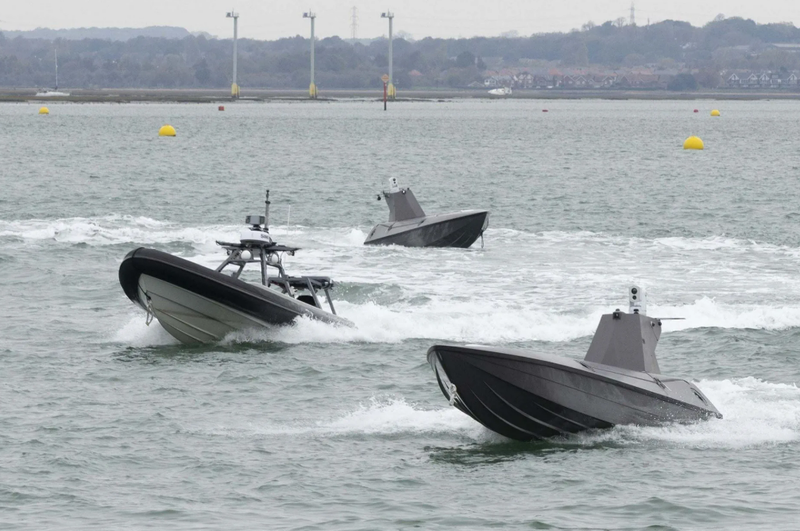
The commissioning event included a demonstration of the uncrewed surface vessels (USVs) the squadron will operate, including the Kraken and Rattler vessels, which were manoeuvred around Portsmouth Harbour from a control hub.The Kraken and Rattler boats are an example of the team getting off-the-shelf technology built and adapted for military use on operations in a shorter time frame, according to the Royal Navy.
The navy has earlier launched strike drones from an aircraft carrier for the first time, in a major step towards transforming how Britain fights at sea. In landmark North Atlantic trials, which took place in mid-October, British-made Nyan Maritime one-way drones, manufactured in Wiltshire by Callen-Lenz, took off from HMS Queen Elizabeth’s flight deck, demonstrating how autonomous strike systems could operate alongside F-35B stealth jets. The trials developed understanding how uncrewed strike systems could contribute to future Carrier Strike operations and wider Defence activity.
Working with experts from across the Armed Forces and industry, the Royal Navy conducted a number of flights from HMS Queen Elizabeth, following the drone's first launch at sea from the experimental ship XV Patrick Blackett earlier this year.