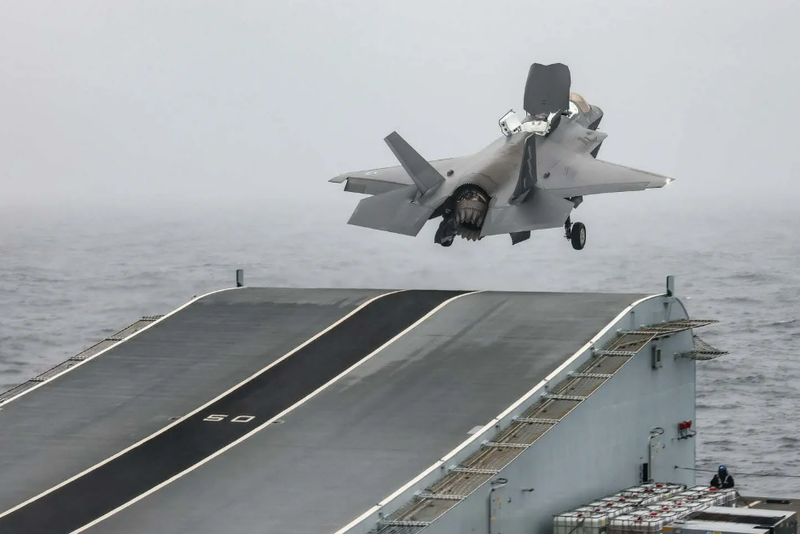
Royal Navy's aircraft carrier HMS Prince of Wales scrambled its F-35B Lightning II fighters to intercept a Russian Tu-95 Bear long-range bomber during NATO operations off Norway.
As informed, the interception took place during Neptune Strike 26-4, a major NATO exercise involving 17 nations, 20 warships and 40 aircraft. The carrier led the northern maritime task group, operating alongside Norwegian, British and French naval forces.
The NATO deployment included Norwegian frigate KNM Fridtjof Nansen, which escorted the carrier alongside the Type 45 destroyer HMS Dauntless. The Type 23 frigate HMS St Albans, a French frigate and Norwegian replenishment ship HNoMS Maud also took part.
The Russian aircraft was detected during the allied force's operations in the region, prompting HMS Prince of Wales to launch its F-35Bs to intercept the bomber.
The carrier's air wing, including F-35Bs from 617 Squadron, also conducted strike training during the exercise, loading and releasing live Paveway IV precision-guided bombs.
Before joining Neptune Strike, HMS Prince of Wales conducted air operations alongside Norwegian Air Force F-35As and escorted a US Air Force B-52 bomber, demonstrating cooperation between allied air and naval forces in the North Atlantic and High North.
The carrier also made a logistical milestone during the deployment, taking on ammunition at the military jetty in Hammernesodden, near Namsos, Norway. It was the first time a Queen Elizabeth-class aircraft carrier had received an ammunition resupply at a port outside the UK. It was also the first time Norway had facilitated an ammunition resupply for an allied country.
The activities formed part of Operation Firecrest, the UK's six-month deployment to strengthen NATO's defense of its northern flank.
The deployment's second phase began in mid-October, following the carrier's return to sea after routine maintenance in the UK. It focused on operations in Arctic and sub-Arctic waters, including the Greenland-Iceland-UK (GIUK) Gap, a strategically important maritime corridor connecting the North Atlantic and Arctic regions.
Commodore Richard Hewitt, Commander of the UK Carrier Strike Group, said Operation Firecrest had demonstrated NATO integration and the importance of maintaining a maritime presence in the North Atlantic and High North.
Following the NATO exercise, HMS Prince of Wales sailed to Oslo to host the Atlantic Future Forum and the International Sea Power Conference before returning to Portsmouth on November 16.